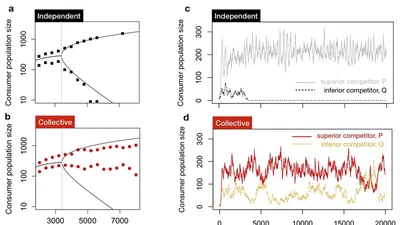
Collective behaviour can stabilize ecosystems
Collective behaviour is common in bacteria, plants, and animals, and thus across ecosystems, from biofilms to cities. With collective behaviour, social interactions among …
ben-dalziel
Collective behaviour is common in bacteria, plants, and animals, and thus across ecosystems, from biofilms to cities. With collective behaviour, social interactions among …
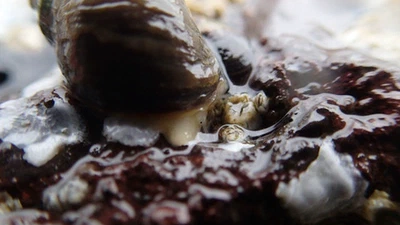
Theory suggests that intraspecific trait variation will alter species interaction strengths through nonlinear averaging when interaction strengths are nonlinear functions of …


Fluctuations and spatial heterogeneity of habitat and resources is thought to underlie niche variation in animal populations, with intraspecific differences serving to produce or …

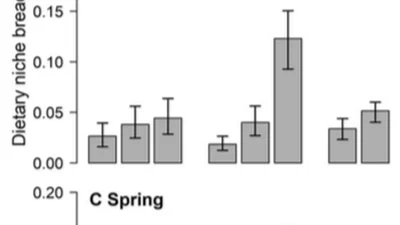
Intraspecific variation is increasingly recognized as an important factor in ecological interactions that can exceed the role of interspecific variation. Few studies, however, …


A central challenge for ecology is to understand the dynamic nature of species interactions. A classic approach to community ecology assumes that individuals within a species are …

Diet variation among individuals within populations is widespread. Often diet dierences among individuals are attributable to obvious differences among individuals such as age, …
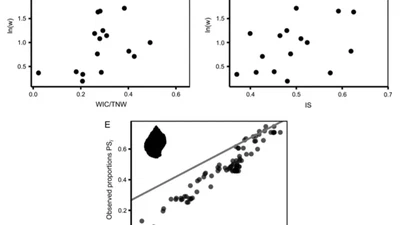
Intraspecific variation in ecologically relevant traits is widespread. In generalist predators in particular, individual diet specialization is likely to have important …
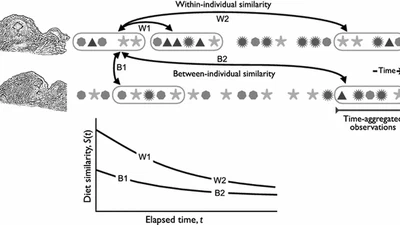
Many populations consist of individuals that differ substantially in their diets. Quantification of the magnitude and temporal consistency of such intraspecific diet variation is …

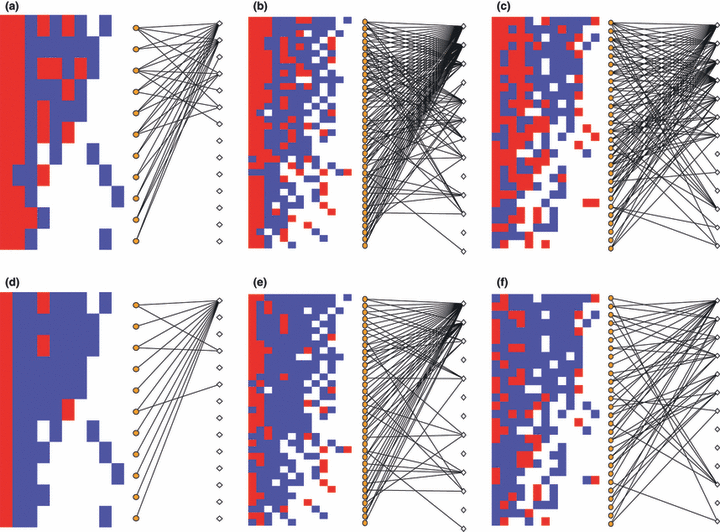
Studies of consumer‐resource interactions suggest that individual diet specialisation is empirically widespread and theoretically important to the organisation and dynamics of …
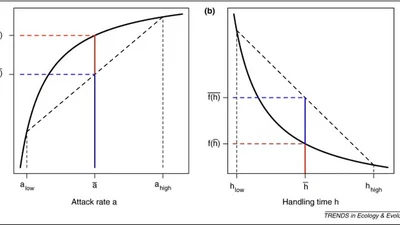
Natural populations consist of phenotypically diverse individuals that exhibit variation in their demographic parameters and intra- and inter-specific interactions. Recent …
A key assumption of the ideal free distribution (IFD) is that there are no costs in moving between habitat patches. However, because many populations exhibit more or less …