Models reveal potential synergies in management actions for bull kelp forest resilience and restoration
2026·, ,,
,,
J. Wilson White
Jess Hopf
Andrés Pinos-Sánchez
Leif Rasmuson
Moritz Schmid
Mark Novak
Journal of Applied Ecology
- Heatwaves are a growing threat to marine ecosystems. Kelps are particularly vulnerable because they require cool, nutrient-rich water to thrive. Heatwave conditions can also trigger increased herbivory by sea urchins.
- Management interventions could mitigate heatwave damage or aid recovery; these include re-seeding kelp spores and manually removing urchins. However, it is unclear a priori what the best timing for those actions are, relative to heatwave onset, and whether combining them could produce synergistic effects. Answering those questions with empirical experimentation is daunting.
- We used a stochastic, stage-structured model of kelp-urchin population dynamics, parameterized to represent bull kelp (Nereocystis luetkeana) forests along the coast of Oregon, USA. The model included a key behavioral switch in urchin grazing, from hiding in crevices consuming drift kelp, to actively foraging on standing kelp stipes when drift becomes rare. Demographic parameters for both species were altered during a simulated two-year heatwave. Two urchin predator scenarios were also considered; one in which the sunflower seastar Pycnopodia helianthoides was driven to local extinction by seastar wasting disease during the heatwave (the historical reality) and the counterfactual where seastar densities remained constant.
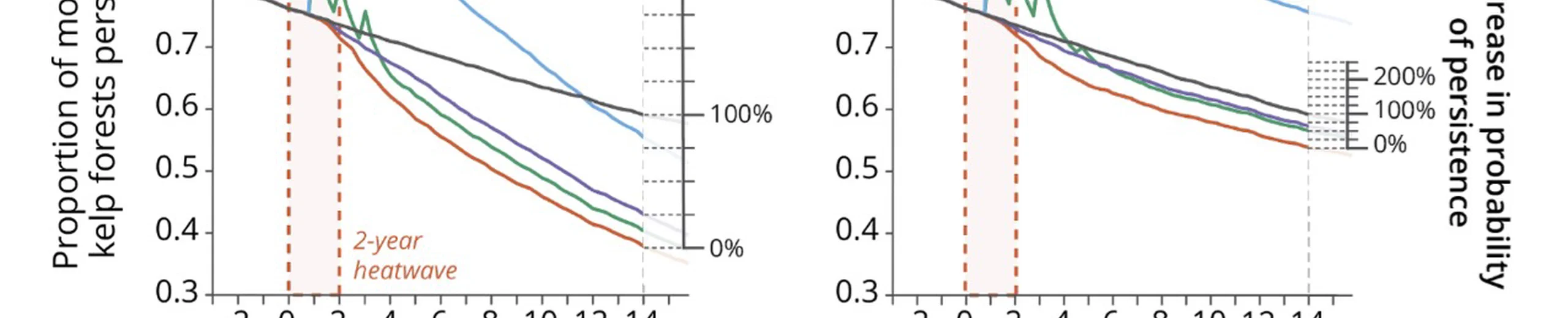
- All management interventions were notably more effective when urchin predators were present. When each was enacted alone, kelp seeding was less effective than urchin removal. Both interventions improved kelp forest persistence most when started near the beginning of the heatwave, but were not effective if started too early. The effectiveness of both interventions increased with increasing effort (% biomass removed or added), but with diminishing returns.
- Combining urchin culling and kelp seeding was highly effective, even more so if urchin culling started first, with large synergistic gains starting at low intensities of kelp seeding (5% of pre-heatwave biomass) and moderate intensities of urchin removal (25% of pre-heatwave biomass).
- Because restoration interventions are time and resource intensive, they should be implemented as part of an adaptive management program. Models such as ours can serve a key role in these programs by setting expectations for the most effective timing and combination of restoration actions.